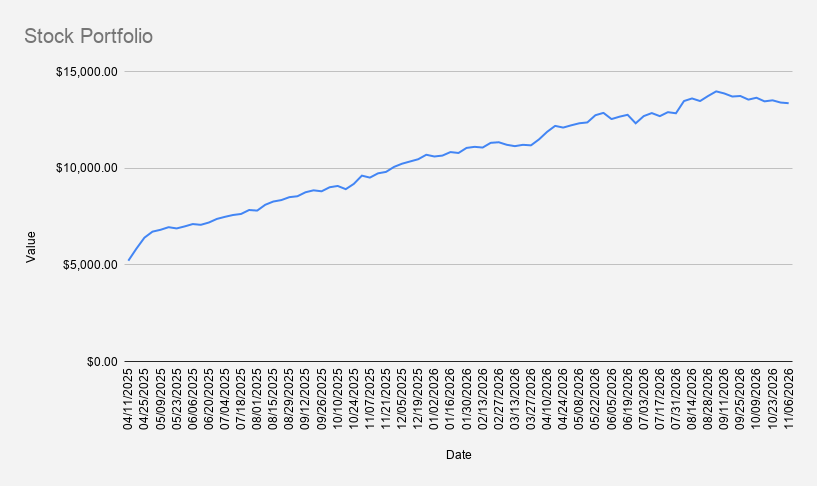
As of November 6, 2026, our options-selling-powered dividend stock portfolio stood at $13,361, marking another slight weekly decrease of 0.25% compared with the previous week.
What a Week on Wall Street!
Wow, what a week! At one point, our portfolio was getting close to cracking the $14,000 mark, only to pull back following Thursday's brutal Nasdaq sell-off. The Nasdaq Composite plunged 5.5%, the S&P 500 lost 4.4%, and Nvidia (NVDA) dropped approximately 9.3% in a single trading session. Ouch! That probably hurt quite a few investors and options sellers, particularly those running bullish credit spreads or leveraged positions in technology stocks.
The sell-off wasn't limited to Nvidia. Semiconductor stocks were among the hardest hit, with AMD, Micron, and several other AI-related names suffering substantial declines. The Nasdaq even entered correction territory, having fallen more than 10% from its recent peak. What made Thursday particularly interesting was how quickly market sentiment changed. Just a day earlier, Wall Street had been celebrating a strong post-election rally. By Thursday, investors were questioning the valuations of AI companies, the enormous spending commitments behind data-center expansion, and the potential regulatory implications of the US midterm election results.
In other words, the market suddenly became much less comfortable paying premium valuations for future AI growth. Once the selling started in semiconductor stocks, it spread across the broader market. For options traders, this was a useful reminder that market conditions can change very quickly. A position that looks perfectly manageable on Wednesday can become significantly more challenging by Thursday afternoon.
Looking at NVDA, I feel increasingly comfortable with my decision to step away from selling credit spreads on the stock about a month ago. It was a profitable strategy while it worked, but the volatility was becoming difficult to justify. My gradual shift toward Bristol Myers Squibb (BMY) cash-secured puts has been considerably less of a roller coaster, although certainly not without risks of its own. BMY isn't immune to market corrections, and pharmaceutical companies come with their own challenges, including drug development, patent expirations, and regulatory uncertainty. Still, at least the price movements have generally been easier for me to manage.
Year to date, our portfolio is up 33.33%, outperforming both the S&P 500 (+8.33%) and NVDA (+0.04%), according to the performance figures I'm tracking. That's a comparison I'm quite happy with, especially considering the turbulence we've experienced this year. More importantly, I believe our portfolio survived this week reasonably well. All open options positions still appear manageable, at least for now. Of course, that can change quickly, as Thursday reminded everyone. And while the comparison is encouraging, it doesn't necessarily mean we're taking less risk than the broader market.
Moving Toward a Sleep-Well-at-Night Portfolio
As I continue working on controlling risk, I'm increasingly attracted to the idea of building what I would call a sleep-well-at-night portfolio. For me, that means selling options on just a few companies, or perhaps even concentrating on one company I genuinely understand and wouldn't mind owning at the right price, rather than managing a basket of unrelated options positions. Fewer moving parts, fewer adjustments, and hopefully fewer unpleasant surprises. Of course, concentration brings its own risks, so position sizing, available cash, and overall exposure remain just as important.
Easier said than done! We still have plenty of options contracts open, and simplifying the portfolio is something I want to work on going forward. One possibility I'm considering is doubling our BMY cash-secured put position, provided the upcoming BMY credit spread expires worthless. That would allow me to reconsider how much capital I want to allocate to BMY, although it would also increase our exposure to a single company. Nothing has been decided yet. After a week like this, I'm in no particular hurry to increase risk.
For now, I'll happily take the 33.33% year-to-date return, keep collecting premiums where the risk makes sense, and focus on protecting what we've already built. Sometimes the best trade is simply not adding another one.
I have to admit, at one point during Thursday's NVDA sell-off, I started wondering whether it might be time to switch back to selling credit spreads. The premiums were becoming very attractive as volatility jumped. That's the tempting part of options trading: when markets become nervous, selling premium can look increasingly rewarding. But those juicy premiums are there for a reason. The market is pricing in significantly more uncertainty, and a sharp move against a short option can easily wipe out several weeks of collected premiums.
Personally, I would still prefer to see NVDA trading closer to $150 before seriously considering returning to that strategy. Not because $150 is some magical support level, but because I would feel more comfortable evaluating new positions at a lower valuation. Whether we'll see that price anytime soon is another question. Perhaps not for quite some time, huh? In any case, I'm not particularly interested in chasing NVDA just because premiums have suddenly become more attractive.
Current Open Options Positions
- BMY NOV 13, 2026: $61 Cash-Secured Put
- BMY NOV 20, 2026: $55/$50 Put Credit Spread
- NFLX NOV 20, 2026: $85/$105 Bear Call Spread
- BAC DEC 18, 2026: $57.5/$60 Bear Call Spread
- LHA (Frankfurt) DEC 18, 2026: €7 Cash-Secured Put
- BAC MAR 19, 2027: $55 Short Put
- NFLX DEC 17, 2027: $64 Short Put
- NVDA JAN 21, 2028: $130 Covered Call
Our open positions now span several expiration dates, ranging from short-term options to long-dated contracts extending into 2028. This gives us exposure to different time horizons, but it also creates different types of risk. Short-term contracts require more active management, while long-dated positions can tie up capital and limit flexibility for many months.
Looking at the list, it also becomes clear why I want to simplify things. We have exposure to pharmaceuticals, technology, banking, entertainment, and aviation, with several different options strategies running simultaneously. On paper, that may look like diversification, but from an options-management perspective, it creates quite a few moving parts. And as Thursday demonstrated, correlations between seemingly unrelated stocks can increase dramatically during broad market sell-offs.
Options Premiums and Margin Debt
Our reported options premiums collected during the week reached $67, slightly more than the previous week. That's still below some of our stronger weeks, but I'm not particularly concerned about maximizing premium income every single Friday. In fact, given the current market environment and our existing challenged positions, I'd rather collect less premium than take unnecessary risks merely to maintain a particular weekly target.
One thing I have learned from years of selling options is that weekly premium income is only one part of the equation. Collecting $100 or $200 in premiums might look attractive, but it means very little if a poorly managed position eventually produces a much larger loss. I'm becoming increasingly interested in the consistency of returns, capital preservation, and how much attention each position requires, rather than simply chasing the highest available premium.
Our outstanding margin debt now stands at approximately $2,359, slightly lower than a week ago and, if I'm not mistaken, one of the lowest balances we've had in quite some time. This is something I'm genuinely pleased about. We keep gradually reducing debt, week after week and month after month. It's not particularly exciting, but having less margin debt means lower financing costs and a little more flexibility when markets become unpredictable.
In theory, if we directed the entire $67 in weekly options premiums toward paying down margin debt, it would take approximately 35 weeks to eliminate the remaining balance. Of course, this simple calculation assumes consistent weekly premium collections, no additional borrowing, and no interest expenses, taxes, trading losses, or other portfolio changes. It is an illustration rather than a repayment forecast, and the margin balance could change for other reasons as well.
Nevertheless, instead of directing every dollar toward debt repayment, we continued making a few small investments. Part of our available capital was reinvested into buying an additional 0.1 BMY share, 1 NU share, and 2 NIO shares. These aren't exactly large purchases, but that's part of the approach. We keep accumulating underlying positions gradually rather than waiting until we have a substantial amount of capital available.
Additionally, we received a dividend payment from BMY, which was automatically reinvested into additional shares through our dividend reinvestment plan. Just as we've been doing with NVDA, we're slowly accumulating more of the underlying stock over time. Not much, admittedly, but every additional fraction of a share contributes to the long-term portfolio. I like the combination of selling options for premium income while gradually building actual stock ownership, even if the process sometimes feels painfully slow.
What I'm Watching Next Week: BMY Takes Center Stage
Looking ahead to next week, my main focus will be Bristol Myers Squibb (BMY). While the broader market will undoubtedly remain important, I'm particularly interested in how BMY behaves following Thursday's sell-off and what happens with our November 11 $61 cash-secured put. This is the position that will require the most immediate attention, and its outcome could influence how I approach the rest of November.
Ideally, I would like BMY to remain comfortably above $61 through expiration, allowing the put to expire worthless and keeping the premium already collected. That would free up the cash collateral for another trade, perhaps another short-dated cash-secured put at a strike I'm comfortable with. However, if BMY trades below $61, I will need to decide whether accepting assignment or rolling the position makes more sense. With a standard US equity options contract, assignment would mean purchasing 100 BMY shares at $61 each, requiring $6,100 before accounting for the premium received.
I'm not necessarily opposed to owning another 100 BMY shares. In fact, that's one reason I've become more interested in cash-secured puts rather than relying exclusively on credit spreads. At least the strategy gives me a clearly defined purchase price for a company I'm already accumulating. Still, owning shares doesn't eliminate downside risk, and I don't want to increase exposure simply because a position has moved against me. My decision will depend on BMY's market price, the premium available for rolling, and how much cash I want to keep available.
The second position I'll be monitoring is our November 20 BMY $55/$50 put credit spread. This trade has a different risk profile, with the maximum spread width limited to $5 per share before accounting for the premium received. For a standard one-contract spread, that means a maximum gross spread exposure of $500, reduced by the initial credit collected. If BMY remains comfortably above $55, the position should become easier to manage as expiration approaches, although a move toward the short strike could still require adjustments.
My longer-term idea is to potentially double our BMY cash-secured put exposure once the existing credit spread has expired or been closed. But there's an important distinction between wanting to own more BMY shares and simply wanting to collect more premiums. Doubling the position means doubling the potential assignment obligation, and I want to make sure the portfolio can comfortably absorb that exposure without increasing margin debt or creating unnecessary pressure elsewhere.
Beyond the options themselves, I'll be watching whether BMY can maintain relative stability while technology stocks remain under pressure. After the company's October 29 quarterly results, I want to keep paying attention to the fundamental picture, particularly its newer medicines, revenue outlook, dividend sustainability, and the challenges associated with older drugs losing exclusivity. The pharmaceutical business is certainly not risk-free, but for now I find it easier to build a longer-term investment case around BMY than to predict the next major move in Nvidia.
I also want to see whether Thursday's market panic was simply a particularly ugly trading session or the beginning of a more prolonged correction. If volatility remains elevated, options premiums may continue to look attractive, but that doesn't automatically mean I should increase exposure. Sometimes higher premiums are compensation for risks that are genuinely increasing. That's something worth remembering before opening another position.
So, for next week, the plan is relatively straightforward: manage the November 11 BMY put, monitor the November 20 credit spread, continue reducing margin debt where practical, and resist the temptation to jump back into NVDA credit spreads just because the premiums look juicy. If the BMY positions develop favorably, I'll reconsider adding exposure. If not, I'm perfectly comfortable collecting less premium and keeping more cash available.
After 83 weeks of tracking this portfolio, I'm increasingly convinced that successful options selling is not about finding the most exciting trade every week. It's about managing positions you can live with when markets suddenly turn against you. Thursday was a useful reminder of that. Let's see what next week brings.