Ireland is not usually the first country that comes to mind when thinking about European stock markets. Most investors looking at Europe tend to focus on larger markets such as Germany, France, or the Netherlands. Yet Ireland has a surprisingly long stock market history and is home to several internationally known companies.
As we are planning a trip to Ireland, I decided to take a closer look at the Irish stock market from an international investor's perspective.
Actually, this has become a bit of a habit. Whenever I visit a new country, I usually end up researching its stock market, major listed companies, and investment opportunities. The funny thing is that while I often do the research, I rarely get around to writing an article about it. This time I want to change that.
To be honest, before starting this research I didn't know that much about Ireland. I knew they use the euro, that Jameson whiskey comes from Ireland, and that the country is located next to the United Kingdom. I also knew that Ireland has its own native language, Irish (or Gaeilge), although English is the dominant language used throughout the country.
From a stock market perspective, the first company that comes to mind is Ryanair. Over the years I have looked at Ryanair stock several times because it is one of Europe's leading low-cost airlines, but never really from the perspective of the Irish stock market itself.
And of course there is Jameson whiskey. Interestingly, investors cannot simply buy Jameson stock. The Jameson brand is owned by French beverage giant Pernod Ricard, which is listed on Euronext Paris.
That brings us to the more interesting question – what does the Irish stock market actually look like?
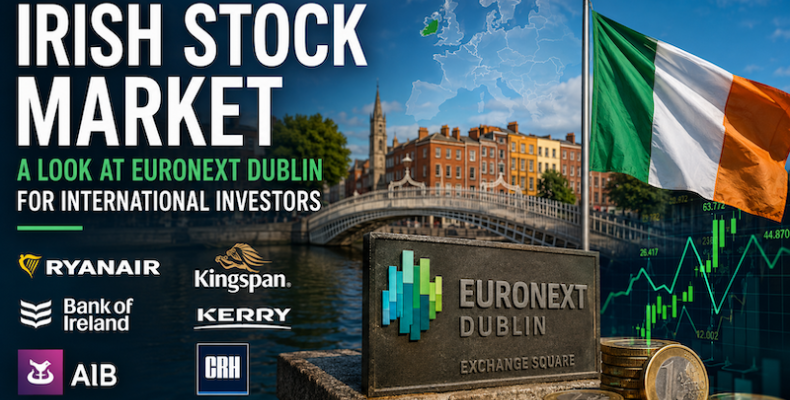
Today, Ireland's stock exchange operates as Euronext Dublin, part of the larger Euronext group that also includes exchanges in Paris, Amsterdam, Brussels, Lisbon, Milan, and Oslo. The integration into Euronext happened in 2018 when Euronext acquired the Irish Stock Exchange.
The history of stock trading in Ireland goes much further back. The original Irish Stock Exchange traces its roots to 1793, making it one of the oldest stock exchanges in Europe. While Ireland is often viewed as a relatively small country on the western edge of Europe, its capital markets have existed for more than two centuries.
Looking at the market today, one thing immediately stands out.
This is not a market designed for day traders.
Compared to major exchanges such as the New York Stock Exchange, Nasdaq, or even some larger European exchanges, trading volumes are relatively modest. For long-term investors, however, that is not necessarily a bad thing. In fact, many successful investments are built around patience rather than constant trading activity.
What surprised me more was the lack of a developed options market for Irish-listed stocks. As someone who likes using options strategies such as covered calls and cash-secured puts, this is a significant limitation. While options are widely available for many German, Dutch, and American stocks, Irish equities generally do not offer the same opportunities.
For dividend-focused investors, however, Ireland may have something interesting to offer.
The Irish banking sector is well represented on the exchange. Companies such as Bank of Ireland Group and AIB Group have returned to profitability after the banking crises of previous decades and currently offer attractive dividend yields. Depending on market conditions, yields around 5% to 6% annually can be found, which is certainly worth noting for income investors.
Among the largest and most recognizable companies associated with the Irish market are Ryanair Holdings, Bank of Ireland Group, AIB Group, Kingspan Group, Kerry Group, and CRH.
Ryanair needs little introduction. It has become Europe's dominant low-cost airline and carries millions of passengers every year.
CRH is one of the world's largest building materials companies. Many investors outside Ireland may not even realize the company's Irish origins due to its global operations.
Kingspan is a global leader in insulation and building solutions, benefiting from growing demand for energy-efficient construction.
Kerry Group operates in the food ingredients and nutrition sector and supplies products to food manufacturers around the world.
Taken together, these companies show that the Irish market is not dominated by technology startups or speculative growth stories. Instead, many of Ireland's largest publicly traded firms operate in traditional industries such as construction, transportation, banking, and food production.
From my perspective as an international investor, Ireland feels more like a market for patient capital than for active trading.
The absence of a significant options market makes it less attractive for some of the strategies I currently use. At the same time, the presence of established businesses, dividend-paying banks, and globally competitive companies gives the market a certain stability.
When comparing euro-denominated stock markets, I still find Germany and the Netherlands more attractive for my personal investing style. Part of that comes from the larger selection of stocks and better liquidity, but also from the availability of options trading.
Some of the European stocks I have followed the most over the years include Deutsche Bank, ING Group, and Lufthansa. Banking and aviation seem to be sectors where European companies remain highly competitive on a global scale. For investors using options strategies, these larger European markets simply offer more flexibility than the Irish market currently does.
That said, Ireland offers something different. The market feels less speculative and more focused on established businesses generating steady cash flow. For dividend investors and long-term shareholders, that can be an attractive combination.
I enjoyed learning more about the Irish stock market.
Every country has its own financial history, and Ireland's stock exchange is a good reminder that even smaller economies can have deep capital market traditions stretching back hundreds of years.
And unlike previous trips where I did the research and forgot to write about it, this time at least I managed to publish the article.