Why I built TerraM Scout, how Hermes got it started, and what happened when Codex took over.
Around February, at an ETH event in Tbilisi, I first heard about AI agents that could do more than answer questions. They could work through tasks, use tools, and help build things.
I wrote about that trip in Tbilisi ETH Hackathon: Finally Making It (and Mostly Drinking Beer). Back then, I came home with conversations rather than a finished app. The idea of agents helping me build and operate my own tools still sounded a little like science fiction.
Now, months later, I have already built several useful apps with their help. One of the biggest gems has turned out to be a small tool I built for TerraM Token: TerraM Scout, or, as I tend to think of it, my LinkedIn Scout.
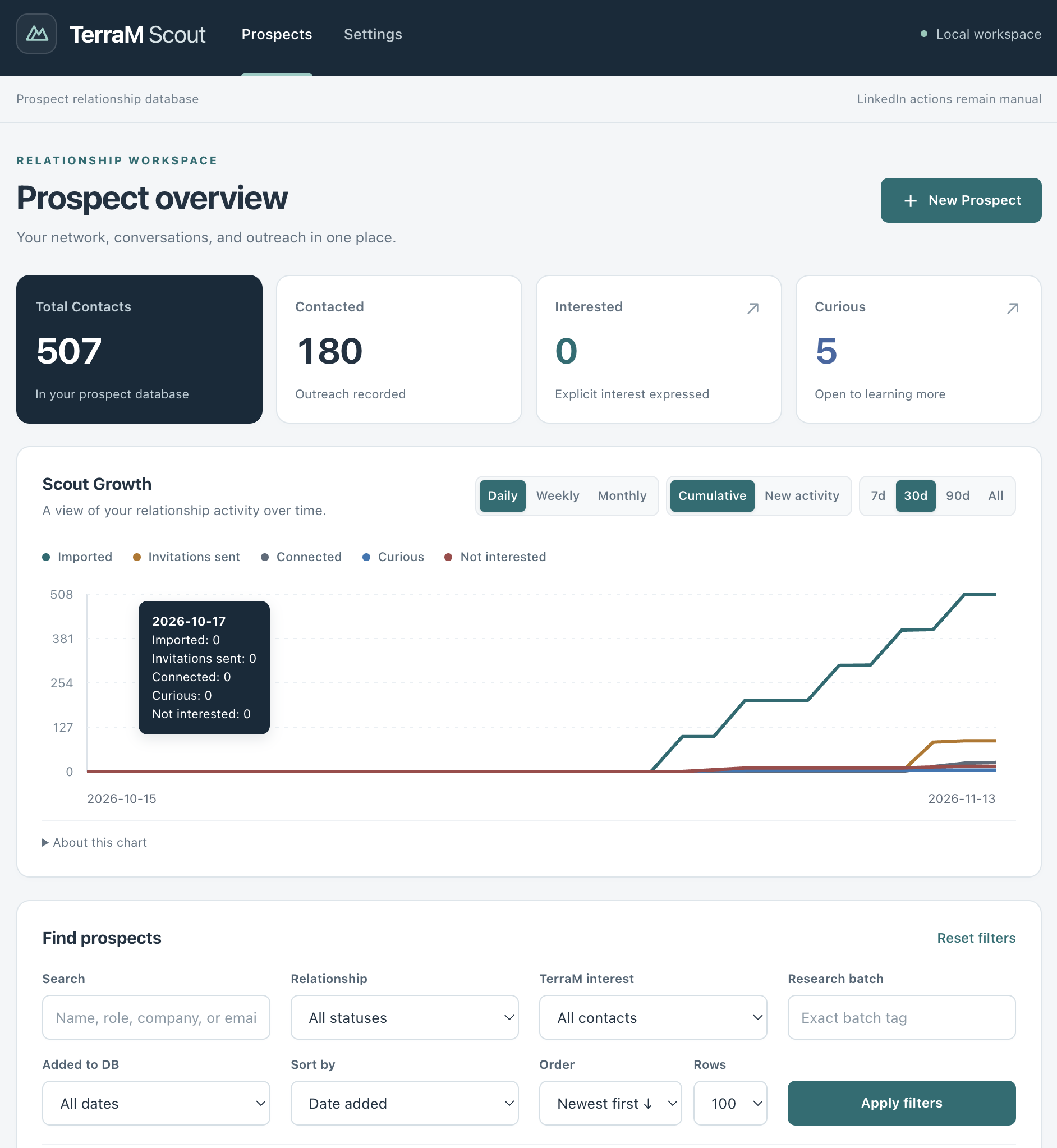
It started with a practical problem. I was connecting with people, sending connection invitations, researching potential contacts, and trying to remember what had happened with each person. LinkedIn held the conversations, but I wanted somewhere to keep the context.
Who was this person? Why had I wanted to connect? Had they accepted? Had I already introduced TerraM? Did they reply, or had I simply seen that they had read the message?
Those are small questions until you are asking them across a growing network. Then they become a reason to build something.
I started building Scout using Hermes. That got the project moving. Later, I let Codex take over the development, and the app kept evolving as I used it.
There was no grand specification at the beginning. I would run into something awkward, describe what I needed, and work on the next improvement. A list became a database. Records gained research, sources, relationship statuses, drafts, and a communication history.
The useful part was being able to return to a person and understand the relationship without reconstructing it from memory.
Right now, TerraM Scout runs locally on my MacBook, on localhost. It is a private app running on my own computer, and that has been enough to get it into daily use.
But it does not have to stay there. I could move it to a virtual private server, or explore adapting it for hosting through ChatGPT itself. Sites in ChatGPT already supports building, hosting, and sharing compatible web apps. Scout would need its own work to fit that environment; moving the database is a different problem from giving an agent access to my signed-in LinkedIn session.
Still, the possibility amazes me. Describe an app, build it, improve it, and potentially host it from the same app. The path from an idea to something I can actually open and use keeps getting shorter.
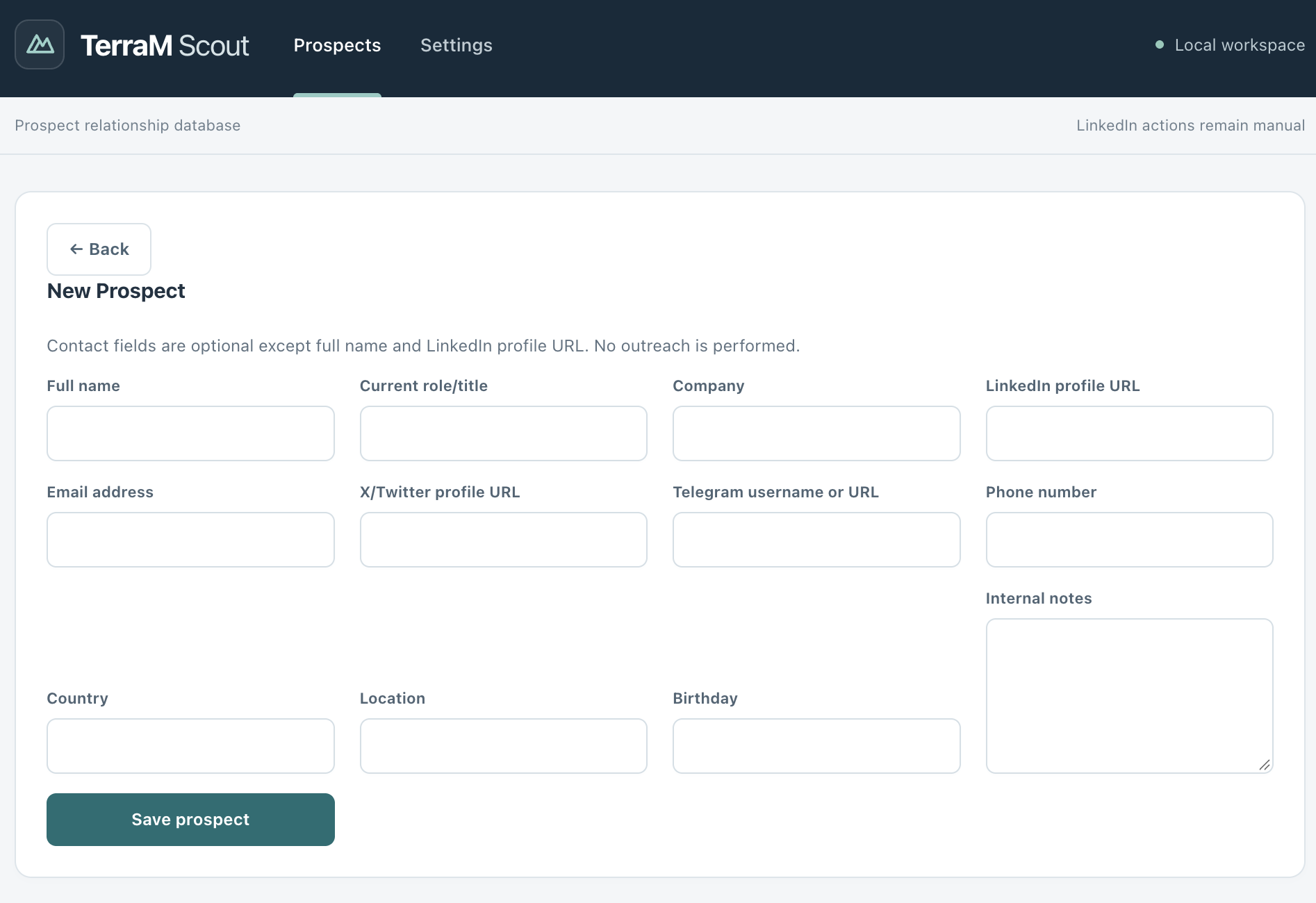
Over roughly two weeks, Scout grew into something closer to a working routine.
I now call that routine “LinkedIn time.”
It can start with checking the latest accepted connections and comparing them with Scout. Sometimes the person is already in the database, but their status still says “Connection requested.” Sometimes their role or company needs updating. Getting those details right is unglamorous work, but it makes everything that follows more useful.
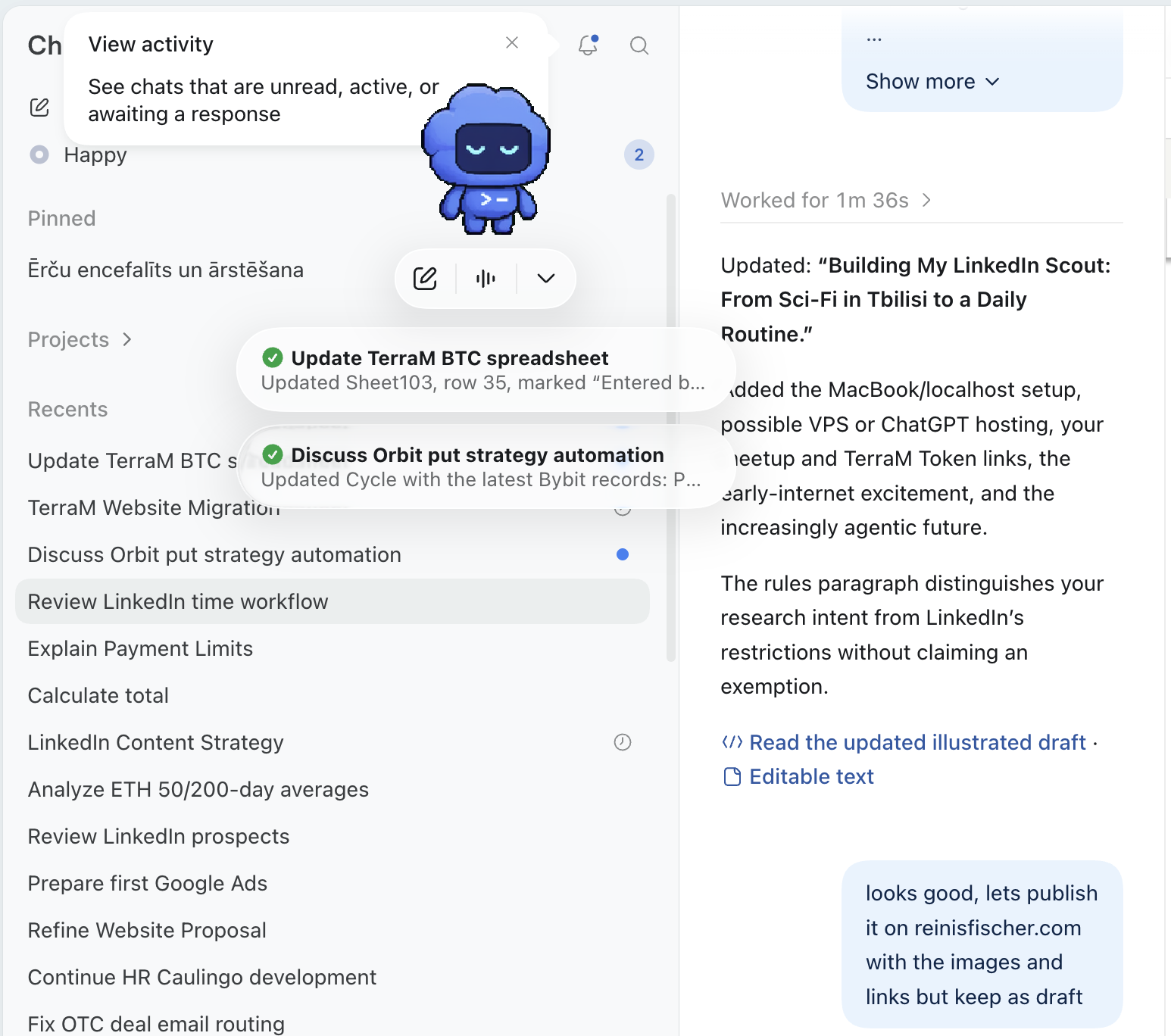
Then comes the research and communication. Why is this person relevant? What have they actually worked on or invested in? Is there a sensible reason to introduce TerraM?
That distinction matters to me. A crypto job title does not automatically make someone a prospective token buyer. An accepted connection does not mean investment interest. A polite reply is still a polite reply.
Scout helps keep those differences visible. It also gives me somewhere to prepare a short, personalized introduction, review it, and retain the exact message after it has been sent.
The latest addition is comments.
Instead of only looking for people to approach, I can review useful posts from my existing connections and prepare a few short comments. No links. No long sales pitch. Just something relevant to what the person actually wrote: a question about a chart, an observation about market structure, or a detail worth discussing.
I see the drafts first. Once I approve them, the comments can be posted and the posts liked, with the outcome recorded in Scout.
That little addition says a lot about how the app has grown. The original problem was keeping track of contacts. Now it also helps me take part in conversations with some context behind what I say.
I still want the judgment to be mine. If a comment sounds generic, it needs work. If there is no useful contribution to make, there is no need to force one.
There is also an uncomfortable question here: does some of this cross LinkedIn’s rules? It might. I think of Scout as a research and relationship workspace, rather than a bulk scraping operation. The purpose is to understand relevant people and keep useful context, not to vacuum up profiles. From the user’s side, the border between assistance and automation can feel thin.
But calling it research does not settle that question. LinkedIn’s published policy prohibits third-party software that scrapes or automates activity on its website. That restriction extends beyond scraping, so reviewing a draft before an agent acts is not, by itself, permission from LinkedIn. I cannot present this workflow as platform-approved.
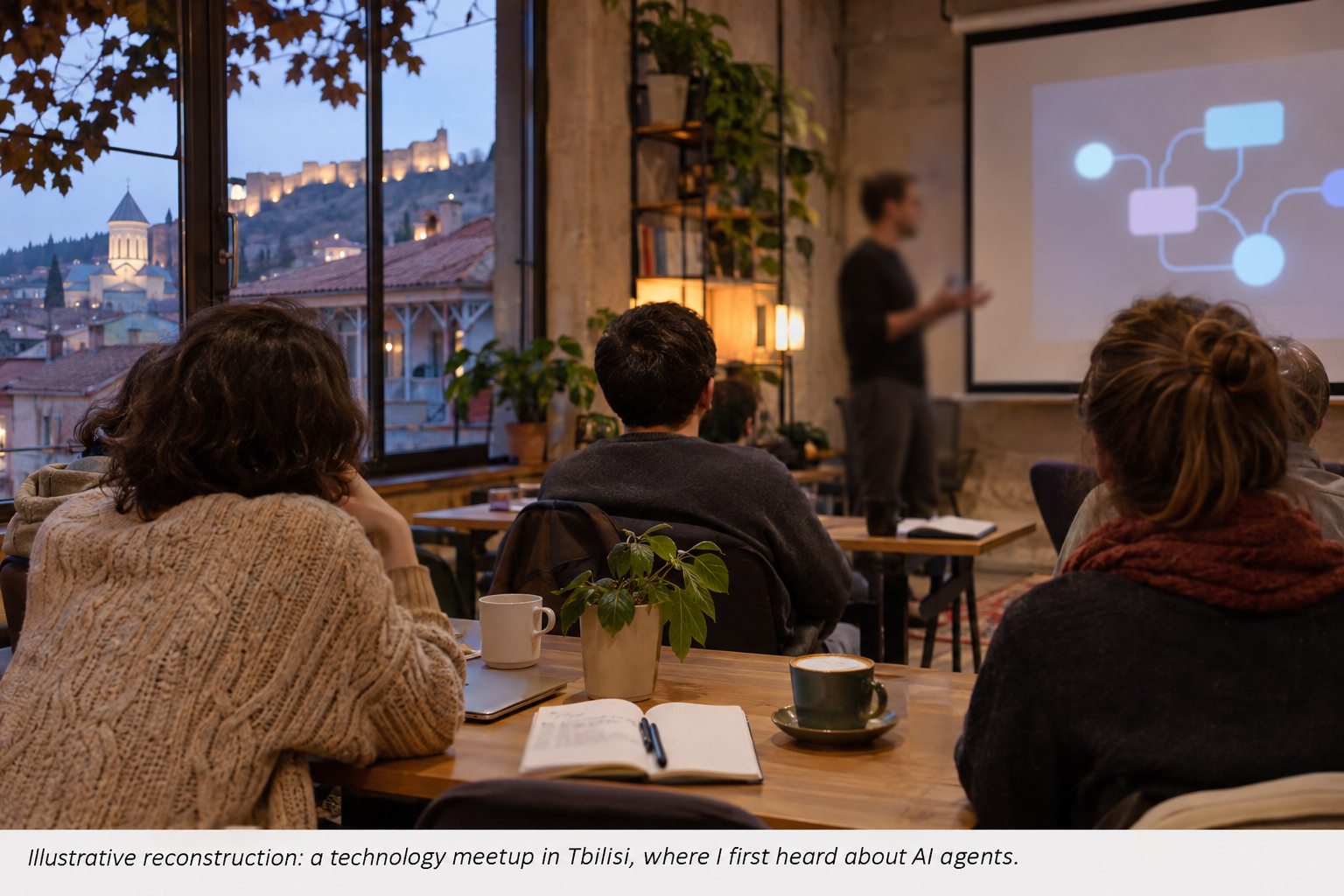
What amazes me is how quickly this has become ordinary.
At that February meetup, I was trying to imagine what working with agents might look like. Now I can describe a feature such as “show me comment drafts first, then post and like once I approve,” and make it part of a tool I use.
There is still checking, correcting, and deciding involved. Sometimes a detail is wrong. Sometimes a workflow needs another pass. LinkedIn has its own limits, and an agent cannot simply wish those away.
But the distance between noticing a problem and having a useful piece of software to help with it has become much shorter. I find that remarkable. Several things that would previously have stayed on my “perhaps one day” list are already working apps.
It reminds me of the internet at the end of the 1990s and the beginning of the 2000s. There was always another website, another tool, another way to do something you had not considered before. That feeling is back, only faster. The internet era on steroids.
There are so many new things to discover that I keep finding another use for the technology before I have finished exploring the previous one. Scout is a good example: I wanted help keeping track of contacts, and a couple of weeks later I am discussing comment approvals and where the app might eventually be hosted.
Now for the less glamorous part of this story: has Scout sold any TerraM tokens?
No. No token sales have come from it so far.
There have been connections, replies, conversations, and now comments. There has been a lot of development. None of that should be confused with a commercial result.
The experiment is only about two weeks old, so I am not ready to draw a big conclusion either way. It is too early to call it a sales success, and I do not yet know which relationships, if any, will lead to a sale.
What I can say is that Scout has already become useful to me. I have a clearer record of who I am speaking with, why I reached out, and what happened next. I can pick up the work with less guesswork and fewer opportunities to repeat myself.
That is why I consider it one of the gems among the apps I have built recently. The organizational benefit is already clear to me. The business outcome remains unproven.
I started with Hermes, continued with Codex, and ended up with a tool that has grown alongside the work itself.
Even LinkedIn already feels increasingly populated by agents: polished posts, neatly structured replies, comments with a familiar rhythm. That is my impression, not proof of who or what wrote any particular post. But using these tools myself makes me wonder how much of tomorrow’s networking will involve agents helping people communicate with other people’s agents.
The future seems more agentic to me. More software taking actions, more people directing and reviewing it, and more questions about what a meaningful interaction looks like.
Eventually, I suspect much of this will become everyday routine. The astonishing things we are trying today will turn into ordinary office tools, complete with permissions, meetings, and boring corporate processes. Perhaps that is what successful technology does: it stops feeling like technology and becomes part of the day.
For now, I am enjoying the discovery. A few months ago, this sounded like sci-fi in a meetup room in Tbilisi. Today, there is a useful little app running on my MacBook, and I am already thinking about where it could go next.