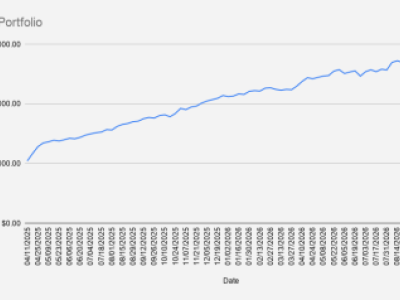
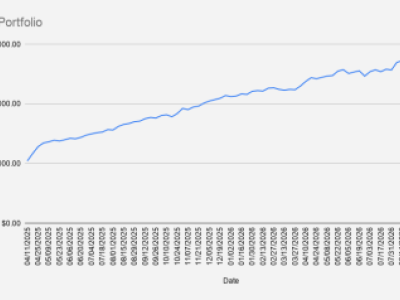
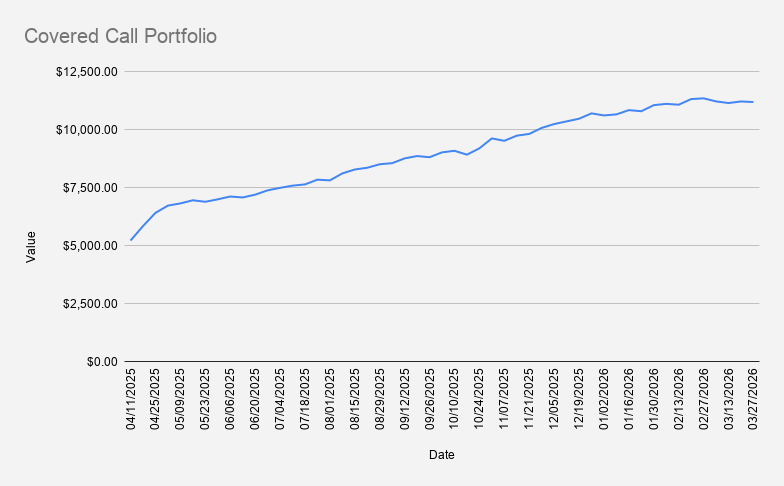
Portfolio Value: $11,183
Weekly Change: -0.24%
YTD Return: +8.50%
Options Premium Collected: $66
As of March 27, 2026, my options income portfolio declined slightly by 0.24%, closing the week at $11,183.
The decline was largely caused by currency fluctuations rather than weakness in the underlying positions. The U.S. dollar strengthened against the euro, with the EUR/USD exchange rate trading around 1.15.
Because part of the portfolio reporting is sensitive to exchange-rate movements, currency fluctuations can materially affect the reported portfolio value even when the underlying stock positions remain relatively stable.
Year-to-date, the portfolio has returned 8.50%, significantly outperforming both the S&P 500 (-7.14%) and NVIDIA (-11.29%) over the same period.
Market Volatility Returns as NVDA Pulls Back
Broader markets experienced increased volatility during the week, with NVIDIA (NVDA) trading below $170 for the first time in several weeks.
The decline appeared to be driven partly by geopolitical concerns in the Middle East and growing fears of disruptions to global energy supplies. Reports discussing a possible blockade of the Strait of Hormuz pushed oil prices above $110 per barrel and increased uncertainty across equity markets.
While geopolitical headlines often dominate short-term price action, my focus remains on managing existing positions rather than attempting to predict political or military outcomes.
For an options seller, periods of higher volatility can create attractive opportunities because option premiums generally increase. The challenge is balancing higher potential income against the risk of larger and faster market moves.
Current Options Positions
- NVDA Apr 3, 2026 160/150 Bull Put Credit Spread
- 2x BMY Jun 18, 2026 50/46 Bull Put Credit Spread
- PFE May 15, 2026 25 Cash-Secured Put
- NVDA Nov 20, 2026 $120 Covered Call
The portfolio continues to use a combination of bull put credit spreads, cash-secured puts, and covered calls to generate recurring income while maintaining exposure to selected long-term holdings.
Using Credit Spreads to Generate Income
The primary source of premium income this week remained NVIDIA bull put spreads.
One reason I prefer credit spreads for a portfolio of this size is their capital efficiency. Compared with cash-secured puts, credit spreads require significantly less buying power while keeping the maximum potential loss defined from the beginning.
This allows me to continue collecting premium without committing too much capital to a single trade or underlying stock.
The trade-off is that defined-risk spreads require more active management. If the underlying stock falls toward the short strike, decisions may need to be made quickly regarding closing, rolling, or restructuring the position.
Reinvesting Premium Into Long-Term Holdings
Using premium collected from NVDA credit spreads, I added another 0.1 shares of NVIDIA, bringing the total position to approximately 101.6 shares.
This remains one of the central principles behind the portfolio.
Rather than treating options income purely as cash flow, I use part of the collected premium to gradually increase ownership of productive assets.
Individual purchases of 0.1 shares may appear insignificant, but repeated consistently over time, they can compound into a meaningful long-term position.
Weekly Premium Income and Margin Debt
This week generated approximately $66 in options premium income.
One of the portfolio's major objectives remains reducing margin debt while preserving a core holding of at least 100 NVIDIA shares.
Current margin debt stands at approximately -$3,508.
At a sustained rate of $66 per week in premium income, it would theoretically take around 52 weeks to eliminate the current margin balance.
In practice, weekly premium income fluctuates, market conditions change, and some positions require adjustments. For that reason, the exact repayment timeline is less important than maintaining a disciplined and sustainable process.
Whether the margin balance is fully repaid during 2026 or the process extends into 2027, the objective remains the same: gradually reduce leverage without selling core holdings or taking unnecessary risks.
Looking Ahead
The primary position to monitor next week is:
- NVDA Apr 3, 2026 160/150 Bull Put Credit Spread
If the position comes under pressure, the management plan remains unchanged:
- Roll the position forward when appropriate.
- Prefer adjustments that collect additional credit.
- Prioritize long-term portfolio stability over short-term perfection.
The goal is not to avoid every losing trade. The goal is to prevent any single trade from causing disproportionate damage to the portfolio.
Key Takeaway
This week demonstrated that portfolio performance is influenced by more than stock prices alone.
Currency movements, geopolitical developments, energy prices, and broader market sentiment can all affect short-term portfolio results.
None of these factors changed the long-term plan.
The strategy remains straightforward: generate premium income, reinvest part of that income into long-term holdings, reduce margin debt gradually, and manage risk conservatively.
In volatile markets, consistency and discipline often matter more than prediction.
Disclaimer
This trade journal reflects activity within my personal investment portfolio and is provided solely for educational and informational purposes. Nothing presented here should be considered investment advice, financial advice, tax advice, or a recommendation to buy or sell any security, option, derivative, or other financial instrument.
Options trading involves significant risk and may not be suitable for all investors. Past performance does not guarantee future results, and all investments involve the possible loss of principal.