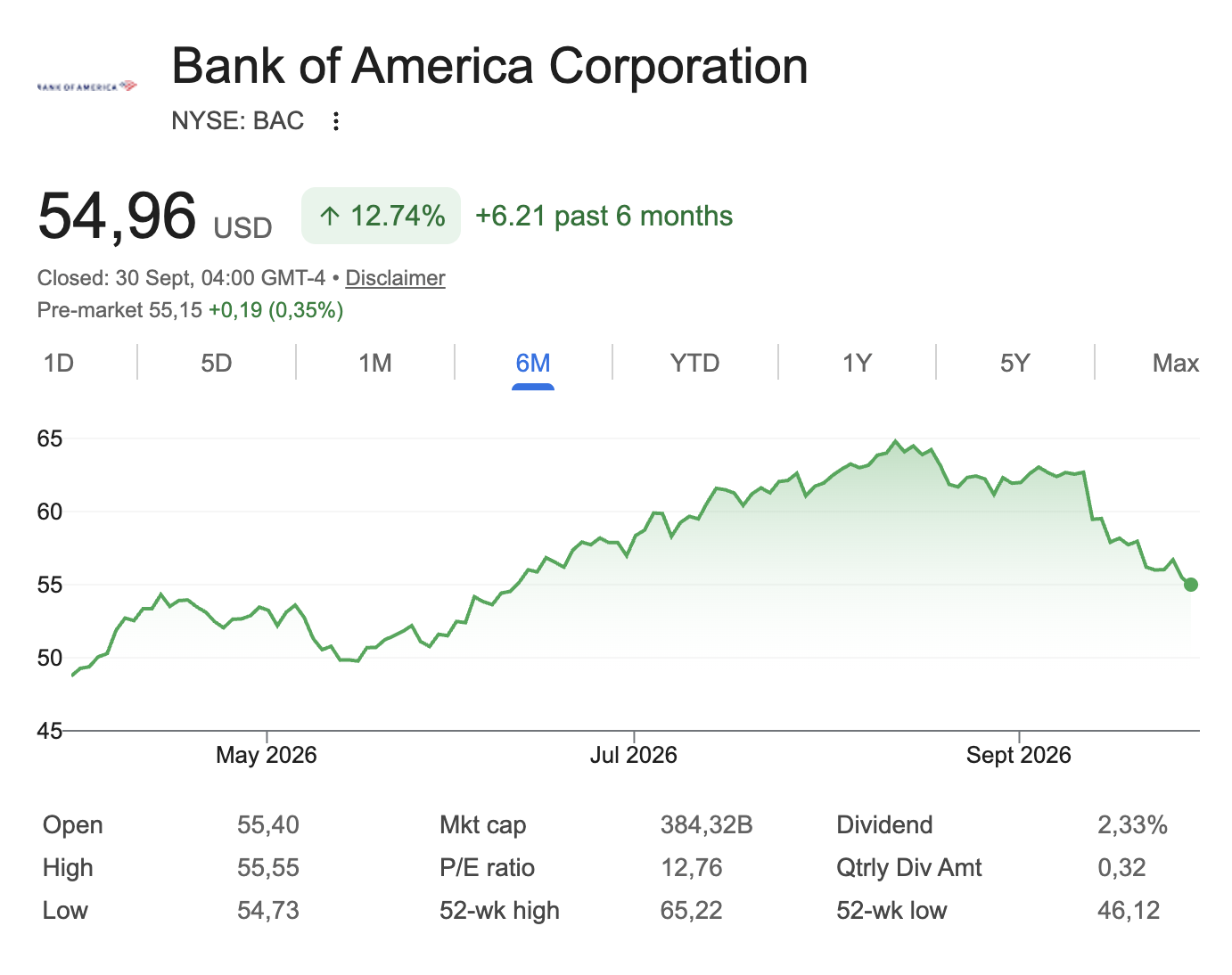
When Bank of America (BAC) fell below my $57.50 short-put strike, I rolled the position down to $55 and out to March 19, 2027. That bought time and improved the potential assignment price, but it also left capital tied to BAC for much longer than I originally expected.
I have since added a shorter-dated bear call spread above that put. This is not a normal weekly trading-journal update. It is a practical question about position management: can I collect a second credit on the opposite side while waiting for a rolled short put to develop?
The answer may be yes, but only if I am clear about the trade-off. The bear call spread is additional premium generation, not downside protection. It has defined risk by itself; the overall BAC position still has substantial downside exposure through the $55 short put.
The BAC position at a glance
| Position | Details |
|---|---|
| Existing short put | BAC $55 cash-secured put, March 19, 2027 |
| Previous short-put strike | $57.50 |
| New bear call spread | 1 BAC $60/$62.50 bear call spread |
| Spread expiration | October 16, 2026 |
| Credit received | $0.14 per share; $14 total before commissions |
| Spread width | $2.50 |
| Maximum call-spread profit | $14 before commissions |
| Maximum call-spread loss | $236 before commissions |
| Call-spread breakeven at expiration | $60.14 |
The BAC position I was already managing
BAC was not a random short put. I have used it as both a stock and options idea because it is a company I can imagine owning over the long term. That was the thinking behind buying Bank of America stock after selling a cash-secured put: if I were assigned, I would own shares in a business where covered calls could later make sense.
The position became more difficult as BAC moved lower. By September 2026, the relevant short-put strike was $57.50. When BAC fell below it, I rolled the put down and out. The new position is a $55 put expiring March 19, 2027, as documented in Week 77’s BAC roll.
The roll did two useful things. It lowered the potential purchase price from $57.50 to $55 and gave BAC more time to recover. It did not erase the earlier problem.
A roll is not a reset button. I closed one obligation and opened another one with a lower strike and more time remaining. The terms may be better, but the position can still become much more expensive if BAC falls well below $55. The price for buying time is that the capital remains committed for another six months.
Why I added a bear call spread
The March 2027 short put remains bullish exposure. I benefit if BAC stays above $55 and time passes without a deeper decline.
The new bear call spread is one $60/$62.50 spread above the market. I sold the $60 call, bought the $62.50 call and collected $0.14 per share, or $14 before commissions. The spread is $2.50 wide, so its maximum profit is the $14 credit and its maximum loss is $236 before commissions.
The $14 is modest. It slightly improves the cumulative economics of the rolled BAC position by $14 before commissions; it does not materially repair it. In exchange, I have introduced up to $236 of defined upside risk on this call spread if BAC finishes above $62.50 at expiration.
The idea is not that I have suddenly become bearish on BAC for the next several years. It is an attempt to collect a small additional credit while the longer-dated put remains open. The put wants BAC to remain healthy; the October 16 call spread does not want BAC to rally too far before then. Instead of one clearly bullish position, I now have a position that is more comfortable within a range.
What happens when I combine these positions?
| Position | What it generally prefers | Main risk |
|---|---|---|
| BAC March 19, 2027 $55 short put | BAC above $55 over time | A substantial fall in BAC |
| BAC $60/$62.50 bear call spread, October 16, 2026 | BAC at or below $60 through October 16 | A strong BAC rally through $60, with maximum loss above $62.50 |
| Combined position | BAC trading inside a workable range | Either side becoming challenged at a different time |
At the October 16 expiration, the call-spread payoff is straightforward. At BAC $60 or lower, I keep the full $14 credit before commissions. Between $60 and $62.50, that profit declines dollar for dollar as BAC rises. At $60.14, the call spread itself is approximately at breakeven. At BAC $62.50 or higher, its loss is capped at $236 before commissions.
These numbers apply to the bear call spread itself, not to the full BAC position. The March 2027 $55 short put remains the dominant downside exposure. The short put benefits when BAC stays above $55, rises, or at least stops falling; the call spread benefits when BAC remains below $60. The combined position increasingly prefers a range: high enough to keep the put from becoming a deeper problem, but not so high that the short call comes under pressure.
That is not a stable balance. The positions have different expirations, different strikes and different behavior as BAC moves. A large decline can still hurt the short put much more than the limited call-spread credit helps. A strong rally can make the put look better while making the short call urgent.
Is this basically an iron condor?
Not technically.
An iron condor is normally opened as one coordinated four-leg trade: a defined-risk put spread below the market and a defined-risk call spread above it, usually with the same expiration. The total credit and maximum risk are evaluated together from the beginning.
My BAC position arrived here through a different path. The long-dated short put is the result of a challenged position and a later roll. The bear call spread was added later for a different reason and on a shorter timetable. I do not have a coordinated, same-expiration four-leg position with a long put defining the downside of the BAC short put.
The economic shape can resemble pieces of an iron condor, but calling it one would hide the important part: this is a layered adjustment, not one planned trade. My experience with an iron condor that became unnecessarily complicated is a good reminder that a familiar label does not make a position simple.
Why the bear call spread is not downside protection
This is the central distinction.
If BAC falls hard, the $60/$62.50 bear call spread may expire profitably, but its gain is capped at $14 before commissions. The March 2027 $55 short put can continue losing value as BAC declines, and that loss can be far larger than $14.
So the spread offsets only a small amount of downside damage. It does not cap the put’s risk or turn the position into a hedge. If BAC rallies sharply, the $55 put improves, but the call spread can lose up to $236 before commissions once BAC is at or above $62.50 at expiration. A defined maximum loss on the spread does not mean the combined position has defined risk; the short put remains the larger downside exposure.
I learned that lesson while managing a losing NFLX short put with a bear call spread. A call spread can improve the economics of a sideways or weaker market, but it does not make the short put safe.
What NFLX taught me before this BAC adjustment
BAC is not a copy-and-paste version of NFLX. It is a later attempt to apply the same type of adjustment more deliberately, with more awareness of what the extra leg can create.
With NFLX, the trade began in May 2026 as a defined-risk put credit spread. As NFLX weakened, I removed the protective legs and later rolled the short put far out to December 2027. I then added a bear call spread. The first spread was an 80/85 September 2026 bear call spread; after NFLX recovered, it had to be rolled higher and farther out. By late September, the published position was a November 20 $85/$105 bear call spread alongside a December 2027 $64 short put.
NFLX became complicated because one adjustment led to another: a put credit spread, more direct short-put exposure, a long-dated roll, a bear call spread, and then a further call-spread roll after the stock rallied. The overlay did not fail as a structure. It introduced the upside risk that I had accepted when I sold it.
With BAC, I had already rolled the challenged $57.50 put down to $55 before adding the call spread. I am treating the spread as a separate, smaller decision rather than pretending it repairs the original trade. That does not automatically make BAC a better trade. It means I am approaching the additional risk with more awareness of strategy drift.
| BAC | NFLX | |
|---|---|---|
| Original problem | A $57.50 short put came under pressure as BAC fell | A May 2026 put credit spread weakened and evolved into more direct short-put exposure |
| Put adjustment | Rolled down to $55 and out to March 19, 2027 | Rolled out to a December 2027 $64 short put |
| Additional trade | One $60/$62.50 bear call spread, expiring October 16, 2026, for $0.14 credit | Bear call spread initially 80/85 for September 2026, later rolled to 85/105 for November 20 |
| Main downside risk | The $55 short put in a substantial BAC decline | The $64 short put in a substantial NFLX decline |
| New risk | Strong BAC rally through the short-call strikes | Strong NFLX rally through the short-call strikes |
How I plan to manage the BAC call spread
I have not published a BAC-specific profit target, roll rule or exit level for this spread, and I do not want to invent one after the fact. I will manage it as its own position while keeping the longer-dated put in view.
If BAC remains below the short call and the spread loses most of its value early, I can decide whether closing it releases enough risk to justify giving up the remaining premium. There is no prize for holding a nearly worthless spread until the final day if the risk is still meaningful.
If BAC moves toward the short-call strike, I will need to compare the remaining risk, time to expiry and the economics of closing or rolling. NFLX showed why a roll should never be automatic. It is a new trade, not evidence that the previous one was fixed.
If BAC falls substantially, the call spread may help only by its limited credit. The larger question remains whether I still accept the downside and eventual assignment exposure of the March 2027 $55 put. The spread should not distract me from that decision.
Do not repair a trade forever
The temptation with a losing trade is obvious. Each roll or additional credit can make the position feel a little better. But premium received is not the same as risk eliminated.
One sensible adjustment at a time can create a position that is harder to understand: more capital tied up, more dates to watch, more upside and downside boundaries, and more opportunity cost. A simple cash-secured put can become a long-dated obligation with several short-term overlays attached to it.
For BAC, I still need to ask one basic question: if the call-spread credit did not exist, would I still be comfortable holding the March 2027 $55 put? If the answer eventually becomes no, another small credit will not solve the problem. Closing, accepting assignment or simplifying the position can be more rational than repairing it forever.
Conclusion
The BAC bear call spread is an incremental $14 premium trade layered over an already rolled short put. It can improve the economics slightly if BAC stays inside a workable range: above $55 over time and at or below $60 through the October 16, 2026 expiration.
It does not erase the original loss, cap the short put’s downside or guarantee a recovery. The call spread itself has a maximum loss of $236 before commissions if BAC finishes at or above $62.50, while the $55 short put remains the larger downside exposure. That is why I am treating it as a separate decision, not as a magic repair.
I will keep documenting these real position-management decisions in Options Education.