As of November 13, 2026, our options-selling-powered dividend stock portfolio stood at $12,776, marking a rather painful weekly decline of 4.45%.
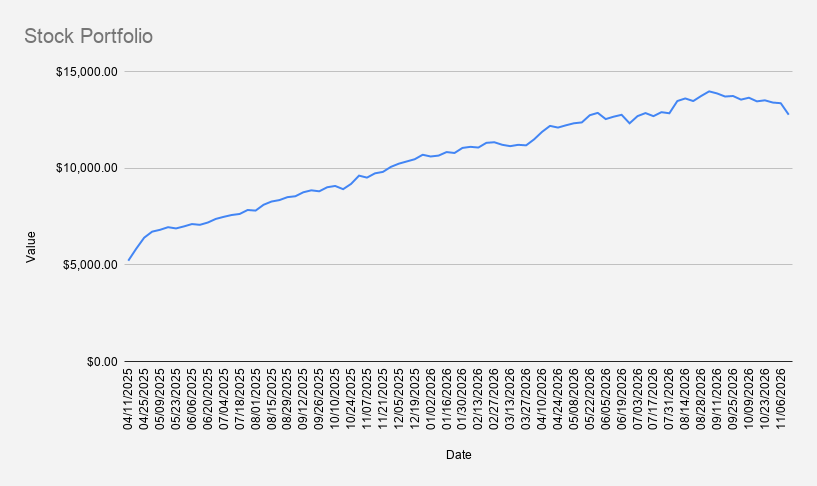
The decline came during another turbulent week on Wall Street, with NVIDIA making headlines for all the wrong reasons and the US dollar strengthening against the euro. With EUR/USD trading around 1.10, the exchange rate is among the lowest I've observed during the past 84 weeks of tracking this portfolio.
Since some of our holdings are denominated in euros while we report the portfolio's total value in US dollars, currency movements add another layer of pressure. Even when the underlying investments hold their ground, a stronger greenback can drag down their reported dollar value. Not exactly the kind of double whammy we were hoping for this week.
Market Overview: NVIDIA Drama, AI Selloff and a Stronger Dollar
What a week! Wall Street had plenty to digest, but the biggest story was undoubtedly NVIDIA. The semiconductor giant found itself in an unexpected leadership crisis following reports about CEO Jensen Huang's personal affairs and subsequent departure. CFO Colette Kress was named interim CEO, leaving investors wondering what comes next for one of the most influential companies behind the AI boom.
The market reaction was anything but subtle. On November 12, NVIDIA shares briefly dropped below $150, reaching an intraday low of approximately $148.80 before recovering to close around $166. The stock had fallen more than 30% from its October record high, showing just how quickly market sentiment can change, even for Wall Street's biggest AI darling.
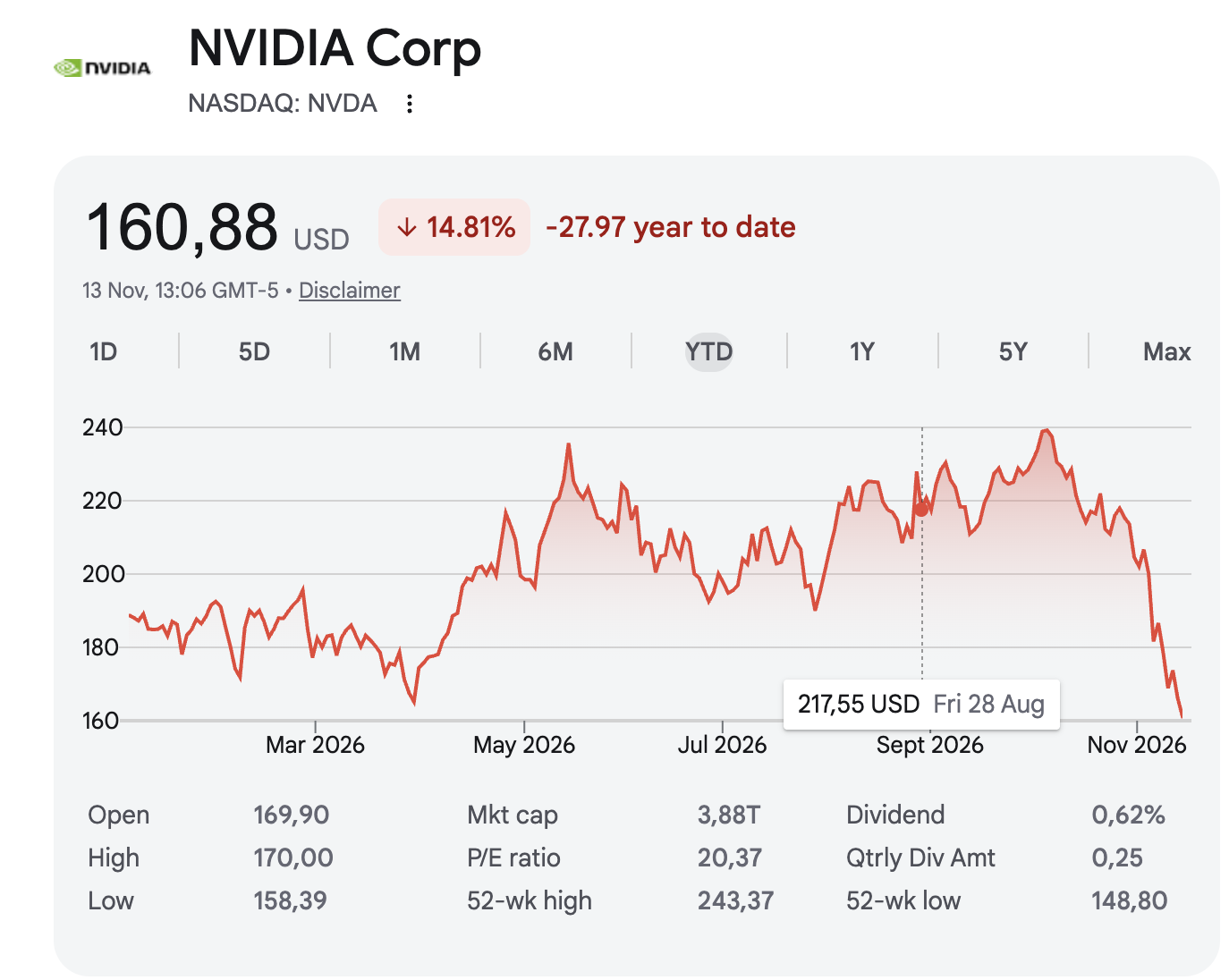
The pressure extended beyond NVIDIA. Other semiconductor and AI-related companies also experienced significant volatility as investors reconsidered technology valuations, AI infrastructure spending and the profitability of the enormous investments being made across the sector.
Interestingly, the broader US market was not nearly as beaten down as NVIDIA. Major indexes were still heading for weekly gains despite the turbulence, reminding us that a painful week for one stock does not necessarily mean the entire market is collapsing.
There was also the familiar inflation story. Elevated oil prices, stubborn inflation and expectations of further Federal Reserve interest-rate increases kept investors nervous. Higher borrowing costs are hardly welcome news for growth stocks, especially those whose valuations depend heavily on future earnings.
Meanwhile, the euro weakened against the dollar, falling toward $1.10 after trading above $1.12 earlier in the week. For our portfolio, that meant additional currency-related pressure.
So, a rather entertaining combination: an AI leadership scandal, interest-rate worries and currency headwinds. Markets never seem to run out of new ways to surprise us.
For additional market context, see Reuters, AP's coverage of NVIDIA's leadership crisis and EUR/USD historical exchange rates.
NVIDIA: Back to Credit Spreads, Perhaps Too Early?
NVIDIA briefly touched $150 during the week, a level I had been forecasting just a few weeks ago when I decided to step away from trading credit spreads on the stock for a while.
Although we still hold a covered call with a $130 strike, it is somewhat encouraging to see NVIDIA finally pulling back. With the position expiring in January 2028, however, there is still plenty of time for things to change. A sustained recovery above $130 could keep our covered call challenged, while further selling pressure would hurt the underlying shares. Let's see.
As NVIDIA approached our entry price, I felt comfortable enough to return to selling weekly credit spreads, collecting some extra premium from the elevated volatility.
Of course, I'm not ruling out the possibility that I'll regret this decision a week from now. Lol. That's the beauty of options trading. Just when you think you've figured things out, the market finds a new way to entertain you.
With all that said, our $15,000 year-end portfolio goal is starting to look like something we might have to carry into another year. Not exactly what I had planned, but that's how markets work.
On the brighter side, year to date, our portfolio is still up 29.7%, comfortably outperforming both the S&P 500 (+9.88%) and NVIDIA (-14.68%), according to the performance figures I've been tracking.
Considering the recent market turbulence, I'd say we're holding up pretty well. The $15K milestone can wait a little longer. Preserving capital and staying in the game matter more.
Current Open Options Positions
- BMY NOV 20, 2026: $61 Cash-Secured Put
- BMY NOV 20, 2026: $55/$50 Put Credit Spread
- NFLX NOV 20, 2026: $85/$105 Bear Call Spread
- NVDA NOV 20, 2026: $130/$125 Put Credit Spread
- BAC DEC 18, 2026: $57.5/$60 Bear Call Spread
- LHA (Frankfurt) DEC 18, 2026: €7 Cash-Secured Put
- BAC MAR 19, 2027: $55 Short Put
- NFLX DEC 17, 2027: $64 Short Put
- NVDA JAN 21, 2028: $130 Covered Call
After our previous BMY put expired worthless, I opened another weekly cash-secured put at the same $61 strike, collecting a rather generous premium of approximately $0.63 per share, or $63 per contract.
At one point, I was even considering selling two BMY puts to collect more than $100 in weekly options premium. However, with all the NVIDIA drama unfolding, I decided to return to trading credit spreads after a short break, opening a $130/$125 spread and collecting enough premium to buy another 0.1 NVDA share.
Not exactly a fortune, but every little bit counts. Slowly accumulating shares while letting volatility pay for them. Let's see if the market appreciates my creativity this time.
Options Premiums and Margin Debt
Our reported options premiums collected during the week reached $85, slightly more than the previous week, although still below the $100 weekly milestone I'd like to achieve consistently.
Reaching $100 per week would translate into approximately $5,200 in annual gross options premiums, assuming we could maintain that pace throughout the year. Not bad for a relatively small portfolio, although collecting premiums is only one side of the equation. What matters is how much we actually keep after losses, trading costs and financing expenses.
Our outstanding margin debt now stands at approximately $2,321, slightly lower than a week ago. We continue gradually reducing debt, week after week and month after month.
It's not particularly exciting, but having less margin debt means lower financing costs and a little more flexibility when markets become unpredictable.
In theory, if we directed the entire $85 in weekly options premiums toward paying down our margin debt, it would take approximately 27 weeks to eliminate the remaining balance. That would put us somewhere around mid-2027. Not a bad goal to pursue, actually.
Of course, this is a simplified calculation, assuming consistent weekly premium collections, no additional borrowing, and no interest expenses, taxes, trading losses or other portfolio changes. Reality rarely follows such a neat spreadsheet.
Still, the idea is appealing: collect premiums, reduce margin and gradually build a healthier portfolio. Slow and boring, perhaps, but increasingly I'm starting to appreciate slow and boring.
Small Investments: Welcome MAIN to the Portfolio
Nevertheless, instead of directing every dollar toward margin debt repayment, we continued making a few small investments. Part of our available capital was reinvested into purchasing an additional 0.1 BMY share, 0.1 MAIN share, 2 NIO shares and 0.1 NVDA share.
Nothing spectacular, but small additions do add up over time.
MAIN is the newest addition to our long-term dividend stock portfolio. I've decided to occasionally accumulate fractional shares to gradually boost our dividend income.
What makes Main Street Capital (MAIN) particularly interesting is that it pays monthly dividends and is also optionable, potentially offering two sources of income: dividends and options premiums.
Of course, selling standard covered calls would require accumulating at least 100 shares, so options income is a rather distant possibility at our current pace.
It will take quite some time to build a meaningful position, especially at the pace of 0.1 share at a time. But that's perfectly fine.
The idea is to keep accumulating, reinvest the income and eventually let compounding do some of the heavy lifting. Slow and boring, once again.
What I'm Watching Next Week: NVIDIA and Bristol Myers Squibb
Looking ahead to the week of November 16–20, my attention will be focused primarily on two stocks: NVIDIA (NVDA) and Bristol Myers Squibb (BMY). Both have options expiring on Friday, November 20, and both could require some decisions before the week is over.
NVIDIA: Will the Selling Pressure Continue?
With NVIDIA, the big question is whether the recent selloff was an overreaction to the leadership crisis or the beginning of a more prolonged repricing of AI stocks.
I'll be watching how the stock behaves around $150, the area it briefly visited this week, and whether buyers return with enough conviction to stabilize the share price.
Our newly opened $130/$125 put credit spread expiring November 20 gives us some distance from the recent trading range, but after witnessing NVIDIA move so dramatically in a single session, I'm certainly not treating that distance as guaranteed protection.
Ideally, NVIDIA stabilizes or recovers, both options in the spread expire worthless, and we keep the premium. If the stock approaches $130, however, I'll need to reconsider the position rather than blindly hope for a recovery. Below $130 at expiry, the spread starts generating losses, with the maximum loss reached at $125 or lower.
Meanwhile, our longer-term $130 covered call remains open until January 2028. That gives us plenty of time, although time can be both a friend and an enemy when trading options.
One thing I'm not particularly eager to do is aggressively increase exposure while the market is still digesting NVIDIA's leadership uncertainty. I've made that mistake before. Sometimes the best trade is simply not opening another trade.
BMY: Another $61 Put, Another Weekly Premium
Bristol Myers Squibb is a somewhat different story. Compared with NVIDIA's roller coaster, BMY has been trading in a much calmer range, with shares closing around $62.32 on November 12.
The company's recent fundamentals also provide some context. In its October 29 quarterly report, Bristol Myers Squibb reported approximately $13.1 billion in third-quarter revenue, up 7%, and raised its full-year revenue outlook.
The company also announced an organizational change on November 12, bringing its research and development operations under a unified leadership structure from January 2027. For a pharmaceutical company, drug development, pipeline execution and future patent expirations remain important considerations.
For our portfolio, however, the immediate focus is much simpler: the $61 cash-secured put expiring November 20.
Having collected $0.63 per share in premium, our effective purchase price would be approximately $60.37 per share if assigned, before fees. That is a price I can work with for a dividend-paying stock we are comfortable holding.
Ideally, BMY remains above $61, the put expires worthless, and we collect another round of premium. If assigned, we acquire another 100 shares and can consider moving into covered-call writing.
Of course, assignment would also require additional capital and could increase our margin exposure, something I'm trying to reduce rather than expand.
If BMY stays relatively stable, I might consider another weekly put. But I would prefer not to increase the number of contracts simply for the sake of collecting more premium. There is a difference between earning income and taking unnecessary risks to reach an arbitrary weekly target.
Week 84 was certainly not our finest in terms of portfolio value. A 4.45% weekly decline is painful, particularly when the $15,000 year-end goal is already starting to slip away.
Nevertheless, with our tracked year-to-date return still at 29.7%, I'm not particularly worried about missing one milestone. Markets will recover, or they won't, and nobody knows exactly when.
What I can control is position sizing, how much margin debt we carry and how aggressively we sell options when volatility increases.
For next week, the plan is straightforward: watch NVIDIA, manage the BMY put, collect premiums where the risk makes sense and avoid doing anything particularly stupid. Easier said than done, I know.
Slow and boring. Let's see whether the market allows us another week of that.